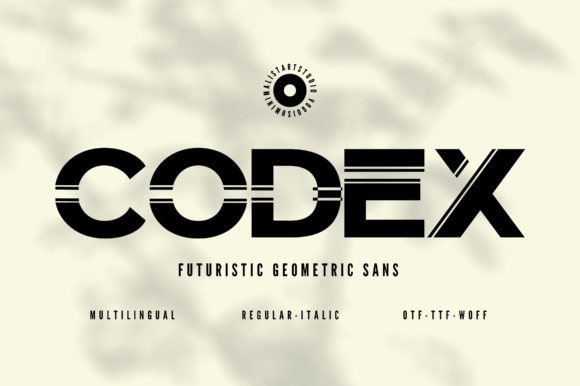
Codex: A Sleek Sans Serif Font for Handmade Brands
If you’re designing candle labels, wedding welcome boards, or printable wall art for your Etsy shop, you know how much a single font can shape perception—before a customer even reads a word. Codex is that rare sans serif font that feels both quietly luxurious and effortlessly functional. It’s not loud or trendy; it’s clean, geometric, and subtly futuristic—like modern minimalism with quiet confidence. As a maker who prints on kraft tags, cuts vinyl for mugs, and designs digital templates for planners and invitations, I’ve tested dozens of “minimal” fonts—and Codex stands out because it works, not just looks nice.
Why Codex Fits Real Craft Projects (Not Just Mockups)
Codex isn’t built for long paragraphs—it’s a display font with purpose. Its tall x-height, open counters, and balanced spacing make it highly legible even at small sizes: think 8pt product tags, 12mm sticker text, or engraved wooden signs. The letterforms are crisp but never cold—there’s a soft precision to the curves and terminals that keeps warmth in handmade contexts. When I used Codex for a set of lavender-scented candle labels (printed on matte kraft paper), customers commented on how “elegant yet approachable” the packaging felt. That’s Codex doing its job: elevating perceived quality without sacrificing clarity.
Where Codex Shines in Your Product Line
- Labels & Tags: Works beautifully on fabric care tags, soap wraps, and boutique garment hangtags—especially when paired with a subtle script for names or ingredients.
- Invitations & Stationery: Perfect for minimalist wedding suites where “less is more” means clean lines, ample whitespace, and zero visual clutter. Try it for ceremony programs, place cards, or RSVP cards.
- Digital Printables: Planner pages, habit trackers, and quote-based wall art benefit from Codex’s neutral elegance—it doesn’t compete with illustrations or watercolor backgrounds.
- SVG & Cut Files: Tested flawlessly in Cricut Design Space and Silhouette Studio. No overlapping paths or rendering hiccups—even at 0.5-inch heights. Great for monogrammed tote bags or farmhouse-style kitchen signs.
- Seasonal & Holiday Designs: Used Codex for a set of linen Christmas gift tags last year—paired with a delicate handwritten font for “To” and “From.” The contrast felt intentional, not forced.
Readability Tips You’ll Actually Use
For physical products, readability isn’t theoretical—it’s about whether someone can read your mug’s tag under café lighting or your sticker at arm’s length. With Codex, avoid ultra-thin weights for small cut vinyl or fine-print packaging. Stick to Regular or Medium for anything under 16pt. For laser-cut wood signs or engraved metal tags, use the Bold weight sparingly—just for headlines or names—to ensure crisp edges. And always preview your design at 100% scale before sending to print or cut: Codex’s clean geometry holds up, but tight kerning pairs (like “To” or “AV”) may need slight manual adjustment depending on your software.
Smart Pairings That Feel Intentional
Codex thrives in contrast. Its strength is neutrality—not personality—so it’s the ideal anchor for expressive companions. Pair it with:
- A relaxed handwritten font for greeting cards or recipe cards (think “Bake with Love” in Codex, followed by ingredients in a friendly script).
- A refined serif font like Playfair Display for wedding stationery—Codex for headings, serif for body text. The combo feels timeless, not generic.
- A bold, condensed display font for social media graphics or sale banners—Codex as subhead or descriptor (“Limited Edition • Hand-Poured • Made in USA”).
Avoid pairing Codex with other geometric sans serifs (like Montserrat or Poppins) unless you’re deliberately building a strict typographic system—it’s too similar in voice and loses distinction.
What’s Included & What You Should Know Before Downloading
The freebie version of Codex includes over 604 glyphs—covering Latin-based languages, standard punctuation, numerals, and common diacritics. You’ll get uppercase, lowercase, numbers, and basic symbols in OTF and TTF formats—fully compatible with Canva, Adobe apps, Cricut, and Silhouette. There are no swashes, ligatures, or stylistic alternates in the free release, which keeps it focused and production-ready. If you later upgrade to a premium version, check for expanded language support (especially if you sell globally) and OpenType features that help automate spacing or alternate characters.
Commercial Use? Yes—But Read the License
This is critical: Codex is offered as a free font, but “free” doesn’t automatically mean “unlimited commercial use.” The license permits use in physical products (stickers, mugs, apparel), digital downloads (printables, templates, SVG files), and client work—as long as you’re not reselling the font file itself or embedding it in web fonts for third-party sites. Always verify the included license.txt or vendor page before listing a Codex-powered product on Etsy or Shopify. When in doubt, reach out to the creator. Most independent font designers are responsive—and they appreciate thoughtful, licensed use.
A Font That Grows With Your Shop
I started using Codex for simple candle labels. Now it’s in my brand guidelines: the go-to for all product names, collection headers, and digital download covers. It doesn’t shout—but it holds space with quiet authority. That’s invaluable when you’re building recognition across stickers, social posts, and packaging. Customers begin to associate that clean, confident rhythm with your shop. Not because Codex is flashy, but because it’s consistently clear, consistently calm, and consistently yours—when paired with your voice, your colors, your craft.